“I Just Turn She Off” The Life and Lessons of Ella Jo
“I Just Turn She Off” The Life and Lessons of Ella Jo
Chapter One: The Quiet Middle Child
Ten miles approximately outside of Challis, Idaho, the land was wide and stubborn, stitched with sagebrush and willows, and broken only by the thin ribbon of a creek that ran through the ranch. It was here that Ella Jo grew up, the quiet middle child in a family that worked the land with their hands and their hope.
Her father ran sheep on the open hills, a small herd that provided both wool and lamb for the table. Every spring, the shearers would arrive, their clippers buzzing as piles of fleece rolled to the ground, the smell of lanolin filling the air. Her mother kept a great vegetable garden and a potato patch big enough to sell from when harvest came. Jars of beans, peas, and beets lined the cellar shelves, while fish from the creek and venison from the fall hunt filled the family’s table in winter. There wasn’t much money, but there was always enough food.
Ella Jo’s parents were deeply in love—everyone said so. There was a quiet respect between them that carried through to the children, who learned by watching, not by being told. Hardship met together, not alone, and that made all the difference.
The children, though, were a mix of noise and need. Perry, the eldest son, born in 1930, was six years older than Ella Jo and already strong enough to help his father with the sheep. Della, born in 1928, was the capable one, her mother’s helper, trusted in the kitchen and the garden. Then there was Ella Jo herself, born in 1936, a gentle, sweet girl who smiled easily but spoke softly. She did not demand attention and was sometimes overlooked, not out of neglect, but because she was not loud or insistent. She was a child who slipped like sunlight through the cracks—always there, always warm, but easy to miss when the house grew busy.
In 1941, a new baby came, a boy named Merritt Pat, after his uncles. But in the house and among the neighbors, he was called Nicky. From the beginning, he was fragile. His small body and almond-shaped eyes marked him as different in a time when people had no kind words for such differences. He was often sick, needing extra care and attention, and the family poured their love and labor into keeping him well.
With Perry shouldering men’s work, Della helping her mother, and little Nicky drawing so much care, Ella Jo sometimes found herself adrift in the family current. She was not the strongest, not the helper, not the baby. She was the quiet one with big eyes who listened more than she spoke. And then, around the age of three or four, a fierce illness—with fever, some said—took her hearing.
After that, the quiet grew deeper.
But even as silence fell heavier in her world, Ella Jo carried her sweetness with her. She was a child who did not complain, who found small joys in the garden rows and the creek side willows, who carried her burdens without demanding others carry them too. Her world was different, but her spirit was steady.
It was in this place—on a sheep ranch along a winding creek, under the watchful eyes of parents who worked themselves weary but loved each other well—that Ella Jo’s story began.
And it was from here that the memories I carry of her were born—like the one I will tell you now, about the day she smiled at a teacher’s scolding and said with a grin, “I just turn she off.”
Chapter Two: The Road to School
As told by Madge Yacomella
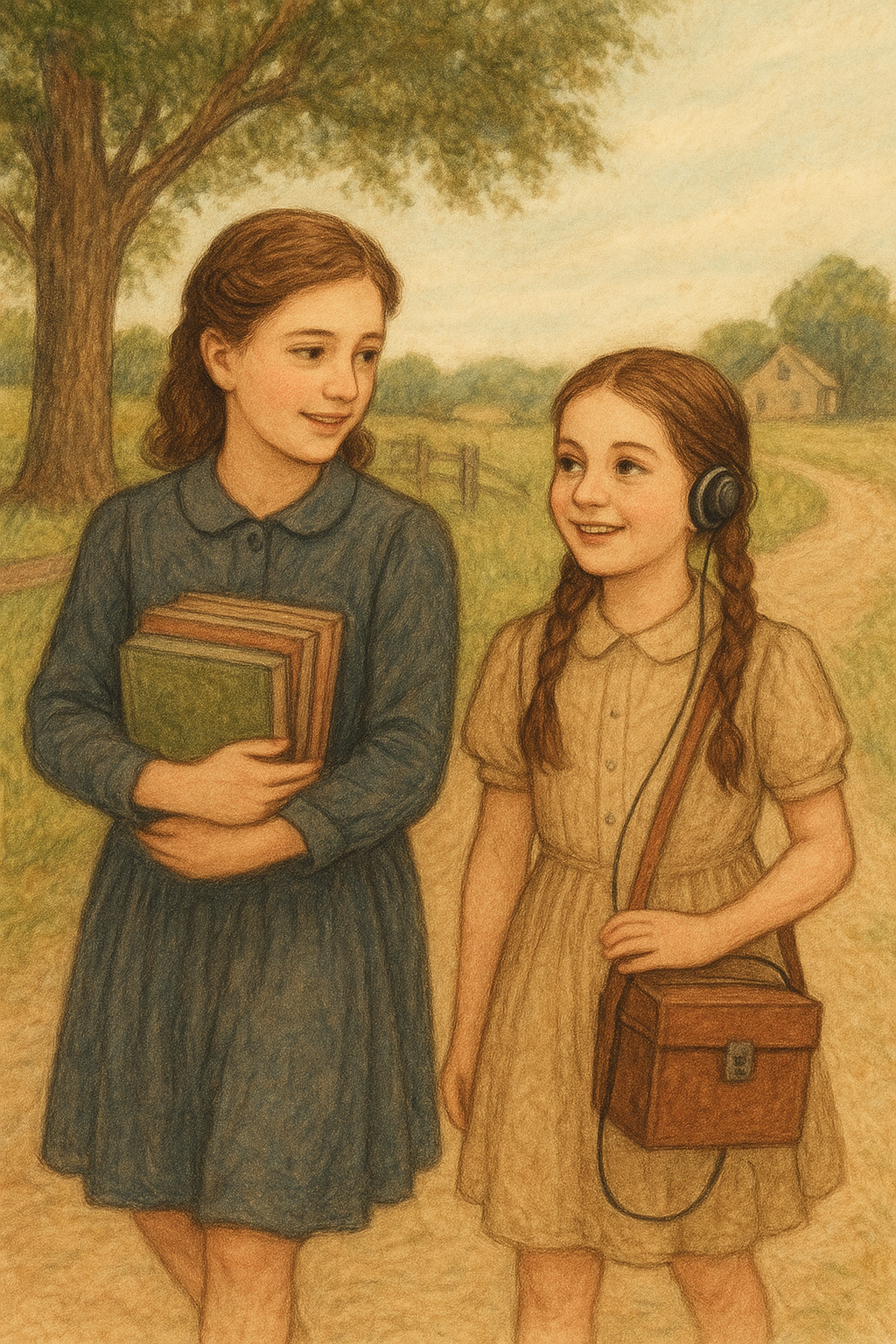
Getting to school from the ranch was never simple. Ten miles approximately from Challis meant that Ella Jo and her sister Della had to depend on whatever plan worked best that day. Sometimes, they would ride old Smokey Jo, the family’s horse, down along Challis Creek to a neighboring ranch closer to town. From there, they’d climb off, tie the reins, and walk the rest of the way with other children. Other days, their father, Lloyd, would hitch up the truck and take the girls into town himself, leaving them at the schoolhouse before turning back to his sheep and ranch work.
The walk home was usually theirs to make. Down dusty roads, across fields, or sometimes to a friend’s house to wait until Lloyd came for them again. Those walks were full of chatter, teasing, and shared secrets, the kind that bind children together forever.
But that particular day, the chatter in the classroom drowned out everything else.
Mrs. Davis had been in one of her moods. Her shoes clicked hard against the wooden floor, and when she looked at you with those sharp eyes, you sat straighter without even meaning to. That morning, she had called on Ella Jo for her spelling, and when the paper wasn’t ready, her voice rose sharp and cold.
Every child in that room froze. No one dared shuffle, no one whispered. Some of the younger ones ducked their heads as if to avoid being next. A few of the boys smirked nervously, relieved it wasn’t them in the spotlight. We all knew what it meant when Mrs. Davis really lost patience—sometimes it ended in a note folded neatly and sent home. A sternly written note, the kind that made your parents sigh and set extra chores on your shoulders.
I sat stiff in my seat, my stomach knotting. I thought for sure Ella Jo would cry. I almost wanted to cry for her. But she didn’t. She just stood there, quiet like a mouse, a small smile tugging at her lips as if Mrs. Davis’s scolding was no more than a breeze rustling through the trees.
When the bell rang and we spilled out of the schoolhouse, whispers started right away. Some children said, “Oh, she’s gonna get it now.” Others guessed Mrs. Davis would write that note home for sure.
Even Della, being the big sister, she was, shook her head and told Ella Jo, “You better get your work done next time, or Pa’s gonna give you an earful.” Perry, if he’d heard about it later, would have likely teased her, “You’ll be in hot water for sure.”
But Ella Jo only walked along beside me, that same little smile on her face.
Finally, I couldn’t stand it anymore. “Ella Jo,” I whispered, “weren’t you scared when Mrs. Davis yelled at you? Why didn’t you cry?”
She looked up at me, her braids swinging, and tapped the big brown box strapped across her shoulder—the hearing aid that set her apart from the rest of us. With a grin, she said, “I just turn she off.”
At first, I blinked in surprise. Then the picture hit me—Ella Jo flicking off her hearing aid as if Mrs. Davis’s sharp voice was no more than a radio to be silenced—and I laughed so hard I nearly dropped my books.
And now, children, I tell you this not just as a funny story but as a truth I have carried with me all my life. That day, your grandmother showed me that sometimes the world will be sharp, unfair, or unkind. But we do not always have to take it upon ourselves. We can choose, like she did, to turn down the noise, to smile, and to walk on.
That is resilience. That was Ella Jo. And it is one of the many gifts she left behind for you.